Is Your Car’s A/C Blowing Warm Air? Don’t Just “Top It Off” with a Can
Summers in Minnesota can catch you completely off guard. One week you are scraping frost, and the next you are sweating through traffic on I-35W. When that heat hits, the absolute last thing you want to experience is clicking on your air conditioning only to be blasted by warm, humid air.
If your A/C is losing its cool, your first instinct might be to head to the nearest auto parts store and grab a DIY refrigerant “recharge” can. They promise a fast, cheap fix.
However, at ADL Auto Repair and Driveshafts in Minnesota, we regularly see these $30 cans turn into $1,500 repair bills. Before you hook up a store-bought can to your vehicle, let’s look at why automotive air conditioning systems fail and why “topping it off” can cause catastrophic damage.
1. Car A/C Systems Are Sealed Ecosystems
An automotive air conditioning system is a closed loop. Refrigerant does not get “consumed” or burned up like engine oil or gasoline.
The Golden Rule of Car A/C: If your system is low on refrigerant, you have a leak.
Simply adding more refrigerant from a retail can does not fix the physical hole in your A/C lines, condenser, or evaporator. The pressure will just force that new gas right back out into the atmosphere—sometimes in a few weeks, sometimes in a matter of hours.
2. The Danger of Overcharging (More is Not Better)
Modern vehicles are incredibly sensitive to the exact volume of refrigerant they hold. Older systems allowed for a bit of guesswork, but newer cars often require an exact weight—sometimes down to the single ounce.
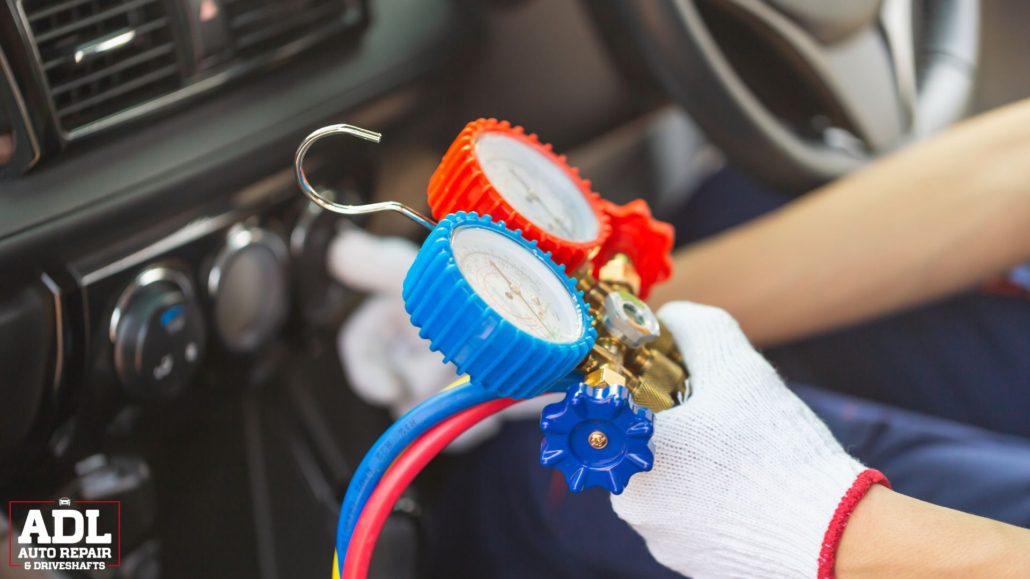
Store-bought cans rely on cheap, built-in low-side pressure gauges to tell you when the system is full. Unfortunately, reading only the low-side pressure gives you less than half the story.
Without monitoring the high-side pressure simultaneously, it is dangerously easy to overcharge the system. Too much refrigerant causes:
- Liquid Slugging: The compressor is designed to pump gas, not liquid. Overcharging forces liquid refrigerant back into the compressor, which instantly destroys its internal pistons.
- System Shutdowns: High pressure triggers safety switches that lock out the compressor entirely, meaning your A/C will blow even warmer air than before.
3. The Nightmare of DIY Stop-Leak Additives
Most over-the-counter recharge cans contain a chemical additive called “Leak Sealer.” It sounds like a helpful feature, but it actually poses a major mechanical hazard to your vehicle.
Manufacturers design these sealers to react with moisture and oxygen, forming a hard chemical plug over tiny holes. The problem? Trapped ambient moisture inside your leaky A/C lines triggers the sealer inside your system. The chemical quickly turns into a gooey sludge that clogs the expansion valve, restricts the condenser, and destroys your compressor’s delicate internal components.
Once stop-leak contaminates your A/C system, many professional shops will refuse to hook up their expensive recovery machines to your car, as the chemical can ruin their equipment. Ultimately, this forces you to replace the entire system rather than just fixing a single leaking hose.
 The Professional Fix: Find the Leak, Fix the Leak
 The Professional Fix: Find the Leak, Fix the Leak
If your vehicle’s air conditioner is blowing warm air, a systematic diagnostic approach is the only way to get dependable, icy cold air back into the cabin.
Don’t gamble with your vehicle’s A/C this summer. If your vents blow warm air, skip the auto parts store and head straight to ADL Auto Repair and Driveshafts. Our team will properly diagnose your system, fix the root leak, and keep you cool in the Minnesota heat.
FAQ
Can I just add refrigerant to my car myself?
While DIY cans are widely available, doing it yourself is highly discouraged. Modern A/C systems require exact, weight-based measurements of refrigerant. DIY cans easily lead to overcharging, which can permanently destroy your A/C compressor or clog the system with harmful “stop-leak” chemicals.
Why is my car A/C cold at first but then turns warm?
This symptom often points to a failing compressor clutch, a faulty expansion valve, or a system that is freezing up due to moisture contamination. It can also happen if the system is slightly overcharged or undercharged, causing the high-pressure safety switch to cycle the compressor off.
How much refrigerant does my car need?
Every vehicle has a specific factory specification, usually found on a sticker under the hood. It is measured in ounces or grams, not by pressure alone. Professional technicians use digital scales to charge the system by weight rather than guessing based on a simple pressure gauge.